Khatushyamji
Haare Ka Sahara — the refuge of all who have lost.
Who Is Khatushyamji?
He is the most powerful warrior who never raised his sword in anger — the supreme sacrificer who won no battle — the defeated hero who became, through loss itself, the eternal god of an age.
Khatushyamji — also known as Shyam Baba, Khatu Naath, Sheesh Ke Daani (the giver of his head), Haare Ka Sahara (the refuge of the defeated) and Lakhdataar (the giver of fortunes) — is revered across Rajasthan, Haryana, Uttar Pradesh, Gujarat and now across all of India and the worldwide Indian diaspora.
He is worshipped as the God of Kaliyuga, the present age of humanity in Hindu cosmology, and his devotees believe he answers every sincere prayer with unfailing compassion. His divine identity originates in one of Hinduism's greatest epics — the Mahabharata — where he was born as Barbarika, grandson of the mighty Bhima, son of Ghatotkacha, and described in scripture as the most powerful yet selfless warrior the world had ever seen.

The Many Sacred Names
Geographic Reach of Worship
Core Region
Rajasthan — Sikar, Jaipur, Kota, Bikaner, Jodhpur.
Extended Region
Haryana, Delhi NCR, Western Uttar Pradesh, Gujarat.
Growing Region
Punjab, Madhya Pradesh, West Bengal, Assam, Maharashtra.
Global Presence
The Indian diaspora across the USA, UK, Canada, UAE and Australia.
A Birth Woven from Three Realms
From the human-divine Pandava bloodline, the supernatural Rakshasa heritage, and the mystical Naga line — a child of impossible convergence was about to be born.
The Pandava Lineage
Barbarika was the grandson of Bhima — second of the five Pandava brothers, the spiritually endowed son of Vayu, the Wind God, and the strongest warrior of his age. Bhima's union with the Rakshasi Hidimbi produced Ghatotkacha, a formidable half-Rakshasa warrior who mastered magical illusions (Maya Vidya) and would later fall on the Kurukshetra battlefield.

How a Mother Was Won — The Three Trials
The Setup
At Indraprastha, Krishna named Kamakatankata, daughter of the demon Mura, as the prophesied bride for Bhima's son — granted invincibility by Goddess Kamakhya.
The Impossible Condition
She declared she would marry only the man who could defeat her both in a battle of wits and in physical combat. Many demon suitors had died attempting it.
The Riddle
Blessed by Krishna, Ghatotkacha posed an unsolvable paradox of a father who deceived his own daughter into marriage.
The Marriage
Defeated in both trials, she surrendered — and, per family tradition, carried him back to Indraprastha on her back.
Pandu
King of Hastinapura, father of the five Pandavas.
Bhima (Vrikodara)
Second Pandava, son of Vayu, the mightiest warrior.
Ghatotkacha
Rakshasa prince — son of Bhima & Hidimba; a warrior of Kurukshetra.
Barbarika
Grandson of Bhima; possessor of the three divine arrows.
Ahilavati
Kamakatankata — Naga princess, demon Mura's daughter.
The Convergence
Pandava (human/divine) + Rakshasa (supernatural) + Naga (mystical).
The Curse of the Yaksha Suryavarchas
Before he was Barbarika, he was a proud celestial being whose boast would, across lifetimes, cost him his head.
The Skanda Purana reveals a detail almost entirely missing from popular retellings: Barbarika was not always destined for this identity. In a previous life, he was a Yaksha named Suryavarchas.
The Boast
When the Devas were oppressed by the Danavas and approached Vishnu for help, the Yaksha Suryavarchas arrogantly declared: "There is no need for Vishnu to curb the Danavas. I shall do it myself."
The Curse
Lord Brahma, angered by this hubris, cursed him: in his next life, he would be killed by Vishnu himself.
The Rebirth
To fulfil this curse, Suryavarchas was reborn as Barbarika. Krishna — aware of this destiny — advised the young Barbarika to worship Goddess Durga to soften the curse's force.
The Naming of Barbarika
Because his hair stood upright, resembling the curly hair of the ancient Barbara tribe, his grandfather Bhima bestowed the name Barbarika:
The Young Devotee & Krishna's Mentorship
Even as a child, he was a fierce protector of dharma — guided personally by the blue god who would one day take his head.
Krishna Personally Directs His Path
Krishna received the young Barbarika at Dwaraka, where the boy asked him directly: "O Madhava, how can one who is born attain their ultimate welfare?" Krishna laid out the dharma of the four varnas — austerity for Brahmins, prowess for Kshatriyas (Barbarika's own class), cow-protection for Vaishyas, and service for Shudras.
He then gave Barbarika a second name — Suhridaya, "the good-hearted one" — and directed him to Guptakshetra, at the confluence of the Mahi River and the sea, to worship Goddess Durga.

The Trials at Guptakshetra
Three Years of Worship
Barbarika worshipped Durga three times daily for three years before she finally appeared, instructing him to await a Brahmin named Vijaya of Magadha.
The Naked Mendicant
When a mendicant criticised his fire-sacrifice as violence, Barbarika struck him — knocking out his teeth. The mendicant transformed into the demon Palashi and fled into a cave leading to the demon city of Bahuprabha.
Into the Subterranean City
Barbarika pursued, defeating a demon army within. The Naga king Vasuki granted him a boon in gratitude. In supreme selflessness, he asked only that the Brahmin Vijaya's spiritual obstacles be removed.
The Twelve-Year Penance & the Teen Baan
Three arrows that could, in sixty seconds, end any war in the universe.
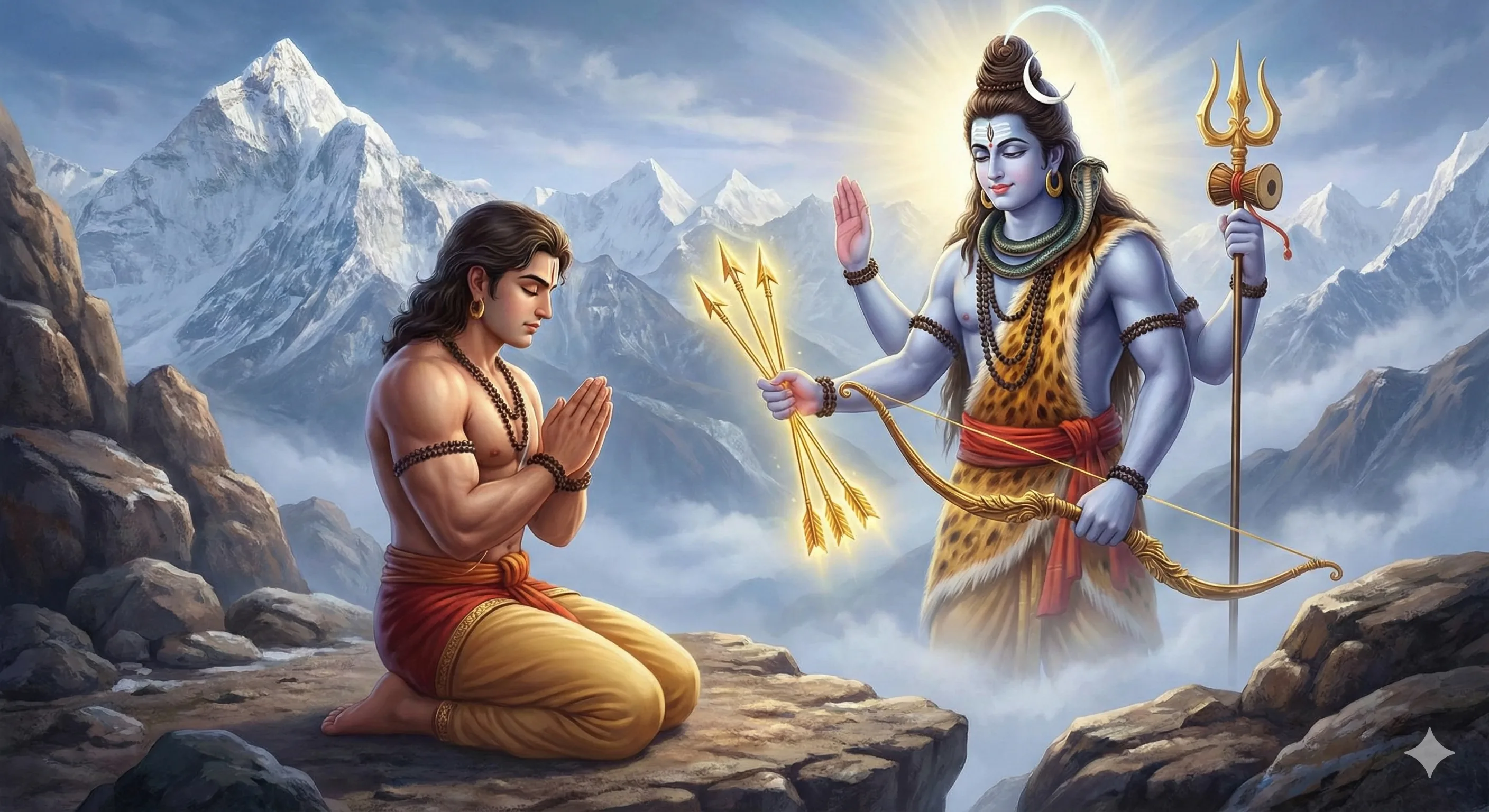
Determined to attain unmatched martial supremacy, Barbarika undertook an agonising twelve-year penance (tapasya) to Lord Shiva. He practised Ekapada Tapasya — standing on a single leg in the Himalayas, without food or water. Pleased by this absolute devotion, Shiva manifested and granted him three extraordinary boons.
| Boon | The Gift | The Power |
|---|---|---|
| First | Three Indestructible Arrows (Teen Baan) | Mark allies & enemies, destroy the marked, and return to the quiver. |
| Second | Victory in any battle he enters | Whichever side he joins will win. |
| Third | Immortality until he wishes to die | Cannot be killed by any being or weapon. |
The Cosmic Mechanism of the Three Arrows
Arrow One
Marks all to be saved. Entities marked are rendered invincible against all celestial & earthly weaponry.
Arrow Two
Marks all to be destroyed. Once marked, evasion or magical defence is impossible.
Arrow Three
Annihilation. Instantly destroys every marked target and returns to the quiver.
When Grandson Lifted Grandfather
A wrestling match is what the simplified stories tell. The Skanda Purana reveals a theological dispute over ritual purity, a divine punishment, and a linga consecrated in awe.
The Thirsty Exiles
The exiled Pandavas, wandering and thirsty, arrived at Barbarika's sacred pond. Yudhishthira instructed Bhima to wash his feet before drinking.
The Dharma Dispute
Barbarika — using his other name Suhridaya, unrecognised — objected: the pond's water was used to bathe the deity. To wash feet in it was defilement equivalent to killing a Brahmin.
The Lift
A fight erupted. Barbarika threw Bhima to the ground and prepared to hurl him into the sea. Only Lord Rudra's voice from the sky (Akashvani) stopped him — revealing Bhima as his own grandfather.
Remorse & Prophecy
Overcome with remorse, Barbarika tried to drown himself. Durga and Shiva intervened, revealing the prophecy: he was destined to die only at Krishna's hands.
The Untold Episode — Bhima's Blindness
After the confrontation, Yudhishthira began praying to Goddess Durga. Bhima mocked this — saying they should worship Krishna or Shiva, not "take refuge in a woman." Bhima immediately lost his eyesight as divine punishment. When both worshipped together, the Goddess appeared — revealing herself as Yogamaya, sister of Krishna — promising to assist the Pandavas at Kurukshetra and prophesying their 36-year reign.
The Vow That Could End the World
A mother's noble instruction carried within it a logical paradox that threatened to annihilate both armies — and force the hand of God himself.
Before his departure for Kurukshetra, his mother Ahilavati (Kamakatankata) extracted from him a sacred vow, rooted in the Kshatriya code of honour:
Within moments, both armies would be utterly destroyed — and the only survivor would be Barbarika himself. This paradox is precisely what forced Krishna's intervention. The war was never meant to be mindless slaughter; it was a cosmic lesson in dharma.
One Arrow & the Peepal Leaves
On the forest road to Kurukshetra, mounted on a blue horse, carrying a quiver of just three arrows, Barbarika was intercepted by a wandering Brahmin.
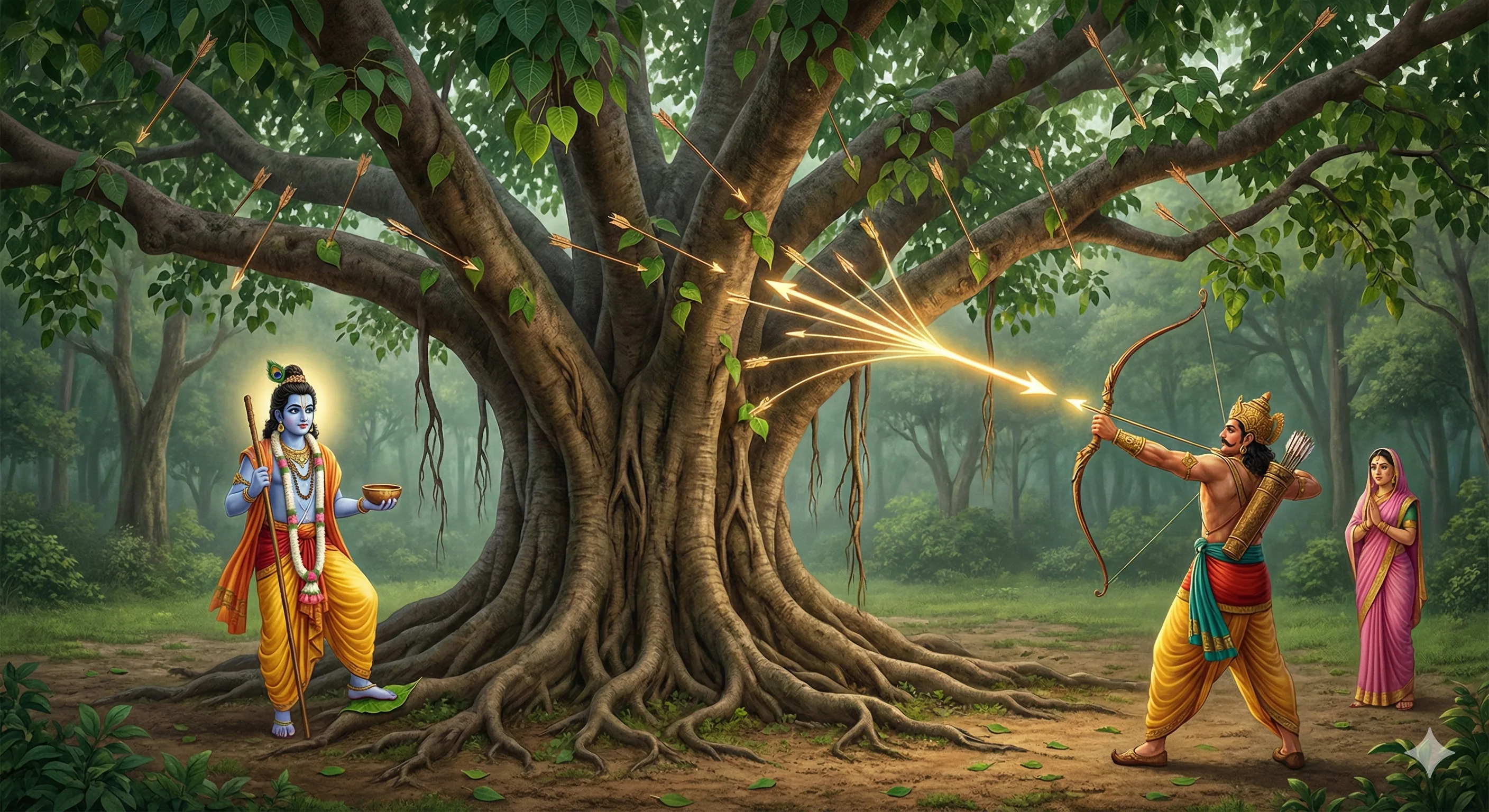
Lord Krishna — the cosmic architect of the war — disguised himself as a Brahmin seeker and intercepted the young warrior near a massive Peepal tree (Ficus religiosa). Feigning ignorance, Krishna mocked Barbarika's arrogance: how could he possibly join a war of millions armed with only three arrows?

The Arrow is Released
Barbarika meditated on Lord Shiva and loosed one arrow. It multiplied into thousands of spectral shafts, marking every single leaf.
The Foot That Hid a Leaf
The arrow did not return. Instead it hovered menacingly around the Brahmin's foot — beneath which Krishna had hidden one fallen leaf.
The Divine Foot Lifts
Realising the arrow would pierce even the foot of the Supreme Lord, Krishna lifted his foot — and the arrow marked the final leaf and returned.
The Supreme Sacrifice — Sheesh Daan
The dialogue that changed eternity. Krishna asked for a head; Barbarika asked only to watch.
Having confirmed the threat, Krishna revealed his true Vishvarupa — the cosmic form — to Barbarika, who bowed in awe. Then began one of the most significant philosophical exchanges in all of Hindu scripture. Krishna explained the fatal paradox: true dharma requires struggle to unfold naturally; an automated slaughter would teach humanity nothing.
Then Krishna made a demand without precedent — he asked for Barbarika's head (Sheesh) as an act of charity (daan), before the battle had even begun.
Personifying the highest ideals of Sharanagati and Nishkama Karma, Barbarika did not hesitate, protest, or negotiate. On the sacred day of Phalgun Shukla Dwadashi (a Tuesday), he willingly severed his own head and offered it to Krishna.
Phalgun Shukla Dwadashi
The 12th lunar day of the bright fortnight of Phalguna — still commemorated in the great festival.
Near Kurukshetra
The battlefield where dharma itself would be decided over eighteen days.
Goddess Chandika's Amrit
The head was sprinkled with divine nectar — conscious, imperishable, capable of speech and vision.
The Witness Who Saw the Truth
For eighteen days he watched, unblinking, the greatest war in human history. Then he dismantled the egos of the greatest warriors who ever lived.
Barbarika's head witnessed every strategic manoeuvre, every divine intervention, every deceit and every tragic death — the fall of Bhishma on his bed of arrows, the slaughter of young Abhimanyu in the Chakravyuha, the death of Karna, and most painfully, the self-sacrifice of his own father, Ghatotkacha. Through it all, he remained the silent, unblinking witness.
The 90-Minute Claim
The Skanda Purana records a striking battlefield moment. When Yudhishthira asked who could defeat the enemy fastest, Arjuna claimed he could kill the entire Kaurava army single-handedly. Barbarika interjected:
He demonstrated — firing an arrow covered in sacred ash from Goddess Durga that marked the vulnerable points of every soldier on both sides, sparing only the Pandavas, Kripacharya and Ashwatthama. It was at this precise moment that Krishna invoked the Sudarshana Chakra and beheaded him.
The Verdict — Who Really Won the War?
After the victory, a fierce debate erupted among the Pandavas over credit. Krishna suggested they ask the only purely impartial witness. Barbarika's answer dismantled every ego in the room — describing not a simple image but a breathtaking composite vision of the Divine.
Upon his revelation, flowers showered from the sky and celestial music played, while Bhima felt ashamed for having claimed personal credit. This testimony forms the theological basis of Sharanagati — individual ego is an illusion; all agency is subordinate to cosmic will.

The Untold Lanka Episode
To further humble Bhima's pride, Krishna took him — via Garuda — to a fathomless lake near Lanka. Bhima failed to fetch earth from its bottom, nearly drowning. Krishna lifted the entire lake with his thumb, revealing it as the very spot where Kumbhakarna's severed tongue (slain earlier by Rama) had landed — demonstrating divine power far beyond any mortal.
Anchored in Scripture
The story of Barbarika is not legend alone — it is meticulously codified in the largest of the eighteen Mahapuranas.
The Primary Source — Skanda Purana
The most authoritative account appears in the Skanda Purana, the largest of the eighteen Mahapuranas — specifically in the Guptakshetra Mahatmya. The narrative unfolds across Chapters 59–68.
| Chapter | Thematic Focus | Significance |
|---|---|---|
| Ch. 59–60 | Courtship & Birth | Ghatotkacha's threefold victory & Barbarika's birth & naming. |
| Ch. 61–62 | Austerities & Early Exploits | The 12-year Ekapada Tapasya, the Teen Baan, subterranean battles. |
| Ch. 63–65 | Battle with Bhima | The sacred-pond dharma dispute, stopped by Akashvani. |
| Ch. 66 | The Kurukshetra Encounter | The Peepal-leaf test, the paradox discourse, the Sheesh Daan. |
| Ch. 67–68 | The Kaliyuga Prophecy | Krishna bestows the name "Shyam" and promises paramount worship. |
The Bhagavad Gita Verse He Lived
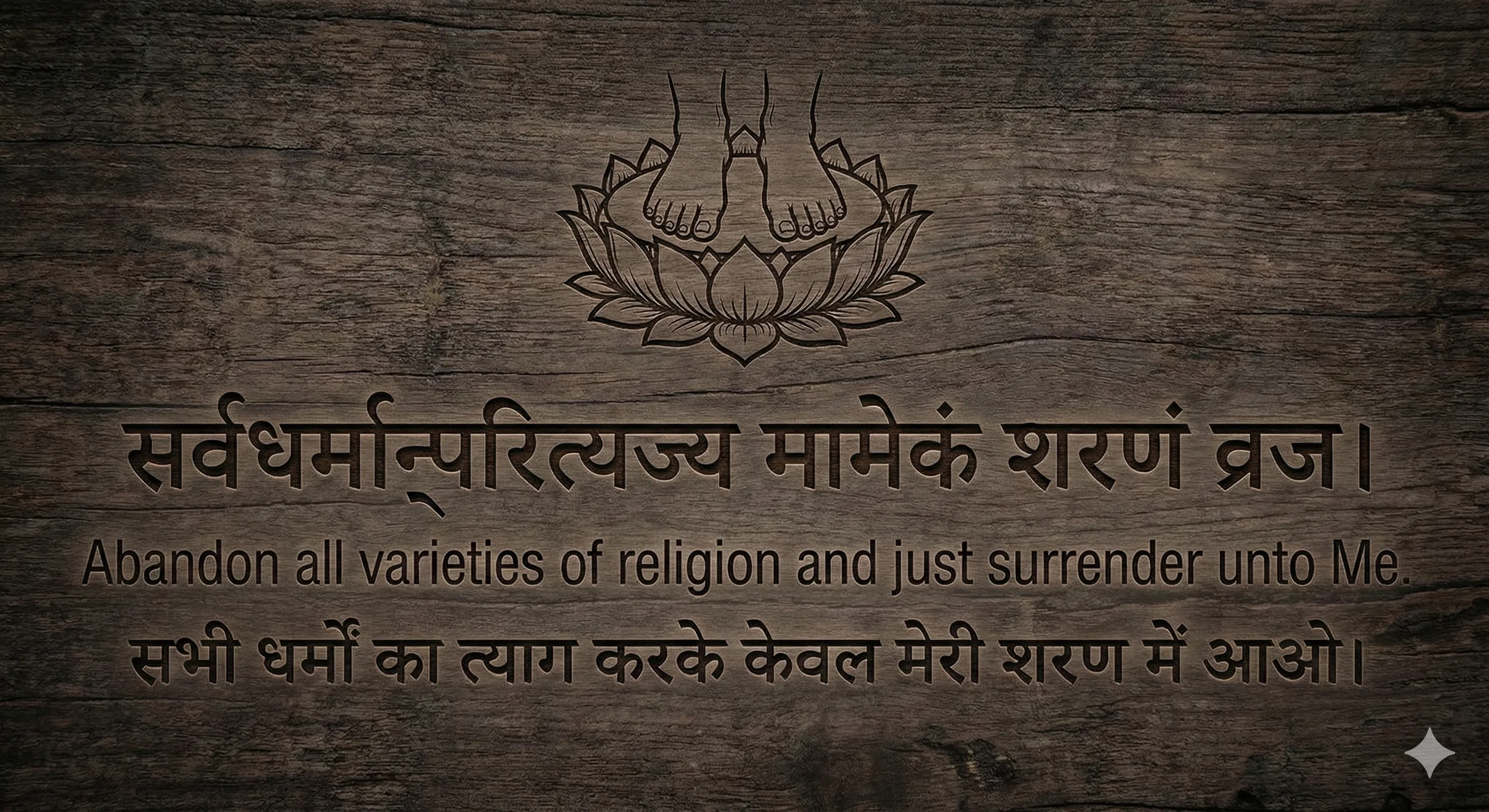
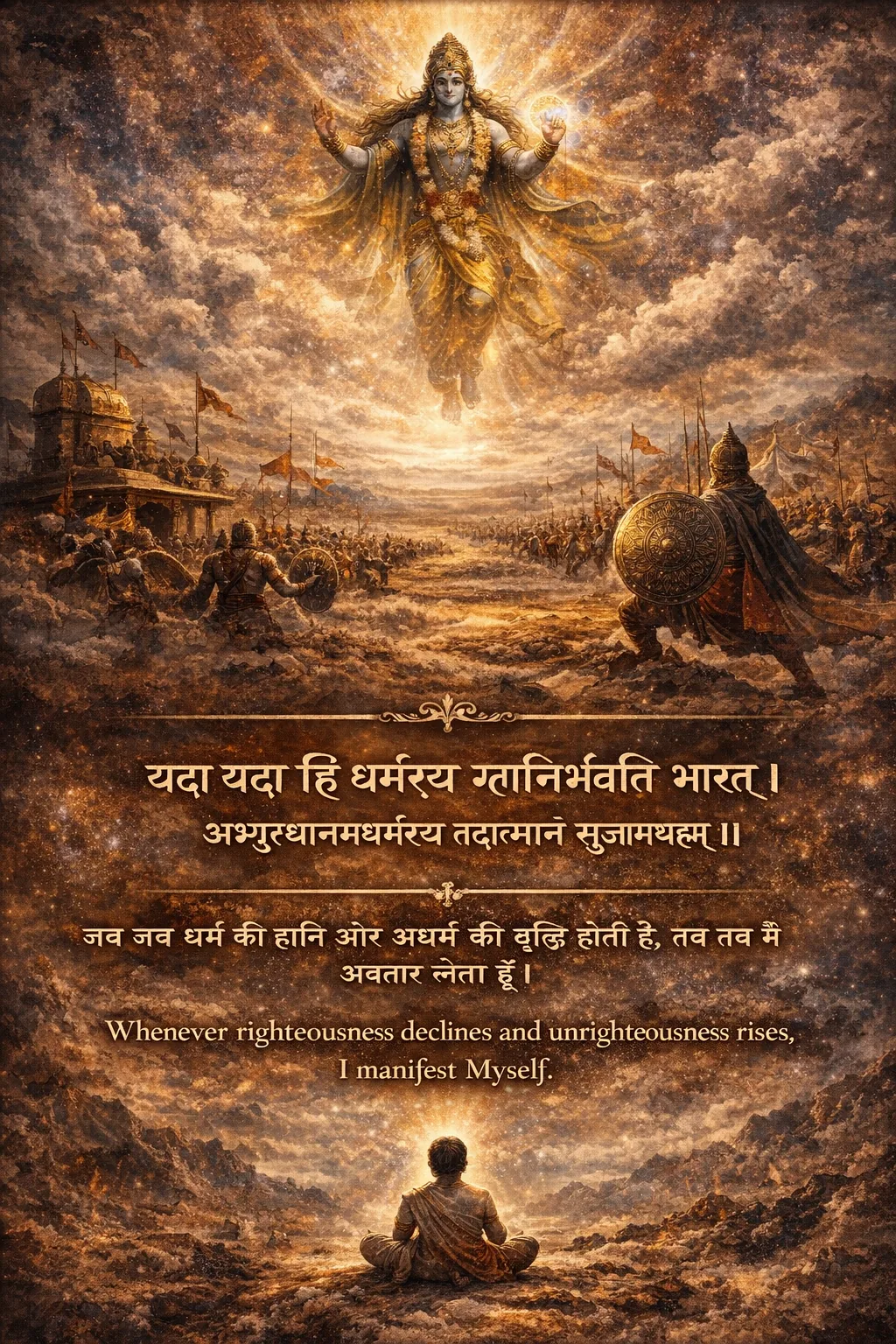
By giving his head without hesitation, Barbarika enacted this verse literally. Devotional literature also references the Brahma Vaivarta Purana, Vishnu Purana, Bhagavata Purana and Brihan-naradiya Purana for the Yuga cosmology — though only the Skanda Purana provides the detailed story itself.
The Promise for Our Age
Before departing the battlefield, Krishna visited the preserved head — and gave a prophecy that would shape the spiritual life of millions, millennia later.
In Hindu cosmology, time is cyclical, moving through four great Yugas. Kaliyuga — the present age — began around 3102 BCE following Krishna's departure from Earth. It is characterised by a decline in righteousness, shortened lifespans, materialism and spiritual confusion — and in this age, the ancient, demanding paths to liberation are considered too hard for the human mind.
The Golden Age
100% righteousness — the age of absolute truth.
The Silver Age
75% righteousness — the age of ritual.
The Bronze Age
50% righteousness — the age of Krishna and the Mahabharata War.
The Iron Age — We Are Here
25% righteousness, moral decline. This is why Khatushyamji's worship grows.
This divine transfer of nomenclature is the exact reason he is known as Khatushyamji or Shyam Baba today — revered explicitly as Kaliyug ka Devta.
The Miraculous Re-Emergence
After the war, Krishna immersed the sacred head in the river Rupavati, blessing it to remain preserved until the destined time.
Between the Mahabharata war (~3102 BCE) and the head's rediscovery, oral tradition holds it remained divinely preserved and hidden — possibly a site of unrecorded local pilgrimage near Kurukshetra, lost to memory through successive invasions and wars, surfacing only at the destined time in Kaliyuga, exactly as Krishna had promised.
Around 1027 CE, in the agrarian village of Khatu, Sikar district, Rajasthan, local herdsmen observed a profound anomaly. A specific cow would routinely detach from the herd, approach a particular earthen mound, and spontaneously release her entire yield of milk directly into the soil — returning entirely dry.
Days 1–13
The cow releases her entire udder of milk onto the ground — for fourteen consecutive days.
The Excavation
Alarmed villagers report to ruler Roopsingh Chauhan; digging reveals the perfectly preserved, luminescent head of Barbarika.

A Queen's Dream & a Temple's Birth
Simultaneously, Roopsingh Chauhan's wife, Queen Narmada Kanwar, experienced a vivid dream. Shyam Baba appeared to her in radiant blue form, pointed to the exact spot, and said: "Dig here at dawn — this place will become a sacred refuge for all of Kaliyuga."

The temple that rose from a queen's dream and a cow's milk — enshrining the sacred head since 1027 CE.
Roopsingh Chauhan & Narmada Kanwar
The royal couple who financed and built the original temple on both physical and divine evidence.
1027 CE · ~8 months
The original stone temple, reportedly completed in about eight months.
Kartik Shukla Ekadashi
Still celebrated annually as Janmotsava, Baba Shyam's birth anniversary.
A Thousand Years of Stone & Devotion
From a modest hilltop shrine to a marble marvel — the temple's evolution across five distinct eras.
The Original Shrine
Roopsingh Chauhan & Narmada Kanwar build a modest stone shrine at Shyam Kund — completed in about eight months. The idol is installed on Kartik Shukla Ekadashi.
The Grand Renovation
Diwan Abhaisingh, minister of the Marwar (Jodhpur) kingdom, undertakes a major renovation on royal orders — establishing the temple's lasting identity with Makrana marble and silver-sheeted doors.
Marwari Merchant Patronage
Wealthy Marwari trader Seth Abeerchand Kothari — who reported his own vision of Shyam Baba — devotes his fortune to expanding the temple. This era raises the surrounding havelis, dharamshalas and the Baori.
The Modern Reconstruction
A major reconstruction adds a marble inner sanctum, widened courtyard, multiple entry gates and a large pilgrim rest-house.
The Government Master Plan
The Devasthan Department's Master Plan, Swadesh Darshan Krishna Circuit funding, the proposed temple corridor, and continuous crowd-management upgrades.


The Living Temple & Its Sacred Geography
80 km from Jaipur, 17 km from Ringas — a Rajputana marvel where every stone remembers a miracle.
Location & Access
The temple sits in the heart of ancient Khatu town, Sikar District, Rajasthan — 27.688°N, 75.024°E — facing east. Jaipur: 80 km (≈1.5 hrs). Delhi: 280 km (≈5 hrs). Ringas Railway: 17 km (≈30 min). Built with lime mortar, marble and tiles, the complex centres on the Garbhagriha (silver-sheeted doors), the Jagmohan prayer hall (12.3m × 4.7m, painted with mythological frescoes), white Makrana marble gates, a gold kalash pinnacle, and the Shyam Bagicha garden that supplies daily flowers.
The Sacred Sites Within the Complex
Shyam Kund
The exact spot where the head was excavated. A ritual dip before darshan is believed to cure physical & mental ailments.
Gaurishankar Mahadev Temple
When a Mughal soldier struck the Lingam with a spear, blood flowed — the spear marks remain visible to this day.
Gopinath Temple
Devoted to Krishna as Gopinath, the Lord of cowherds — linking Barbarika to Krishna's pastoral form.
Samadhi of Aloo Singh
Within Shyam Bagicha — memorial to one of the greatest medieval devotees.
Toran Gate
1.5 km from the main temple — the grand ceremonial arch, now one of India's most photographed religious landmarks.
Shyam Bagicha
The sacred garden — roses, marigolds, jasmine and tulsi — from which flowers are picked each morning.
Heritage of the Whole Town
The Government of Rajasthan's 2016 Development & Management Plan reveals Khatu was never merely a temple — it was a flourishing multi-community pilgrimage and trading town, with merchant capital from as far as Kolkata and Kanpur funding its built heritage over centuries. The plan catalogues 10 heritage structures beyond the main temple: merchant havelis, a stepwell (Baori), the Garh Dharamshala, the Shahi Masjid (testimony to shared heritage), and an ancient Shivalaya.
Haare Ka Sahara — The God of the Defeated
Not the god of winners, but of those who have lost everything. This single theological distinction explains everything that follows.
In the traditional Hindu pantheon, deities are associated with cosmic victory (Vishnu), prosperity (Lakshmi), the destruction of evil (Shiva), or martial power (Durga). Khatushyamji occupies a profoundly different, highly empathetic niche — he is, fundamentally, the god of the defeated.
Because Barbarika was objectively the most powerful warrior in existence — yet was denied the opportunity to use that power, forced to sacrifice his own life, reduced to a severed head watching others claim glory — devotees believe he uniquely comprehends human suffering, failure and desperation.
| Devotee's State | Traditional Gods | Khatushyamji |
|---|---|---|
| Successful, prosperous | Appropriate to worship | Also welcomes them |
| Failed, bankrupt | One may feel unworthy | Specially welcomes |
| Defeated in battle | Seek warrior deities | His own story |
| Lost all hope | No specific deity | His primary devotees |
Who Comes, and Why
Families & Newborns
For the Mundan — the first head-shaving rite. Newlyweds seek blessings.
Students & Youth
Seeking success in exams, careers and fierce competitions.
Businesspeople
Praying for prosperity and rescue from financial crisis.
The Sick & Distressed
Seeking healing and relief from suffering.
Those in Legal Crisis
Seeking favourable verdicts after dedicated prayer.
Leaders & Celebrities
Including President Droupadi Murmu, Vice-President Jagdeep Dhankhar, actor Govinda, and former CM Ashok Gehlot.
The Rhythms of Worship
Five daily aartis, two sacred pilgrimages, one whispered perfume bottle — a liturgy built around surrender rather than mastery.

Five prayer ceremonies each day — Mangala, Shringar, Bhog, Sandhya and Shayan.
The Five Daily Aartis
Mangala Aarti
The deity is awakened before dawn — the most serene, spiritually potent darshan. The temple opens.
Shringar Aarti
The idol is ornamented with floral garlands, gold & silver jewellery, and royal vestments.
Bhog Aarti
The midday food offering (prasadam) is presented, then distributed to the congregation.
Sandhya Aarti
Evening worship — elaborate oil lamps lit, marking day into night with music.
Shayan Aarti
The final ceremony — the deity is put to rest and the sanctum doors are secured.
24-Hour Darshan
On every Shukla Paksha Ekadashi and during the Phalgun Mela, the temple never closes.
Temple Timings
5:30 AM–1:00 PM · 4:00 PM–9:00 PM
4:30 AM–12:30 PM · 4:00 PM–10:00 PM
Ekadashi & Dwadashi — The Sacred Monthly Days
Every month, on the 11th (Ekadashi) and 12th (Dwadashi) of the bright lunar fortnight, the temple draws enormous crowds. Barbarika was born on Kartik Shukla Ekadashi, and he donated his head on Phalgun Shukla Dwadashi — a Tuesday. Roughly 1,00,000 devotees attend each month, with night-long bhajan sessions and the temple open all night.
The Nishan Yatra — The Flag Pilgrimage
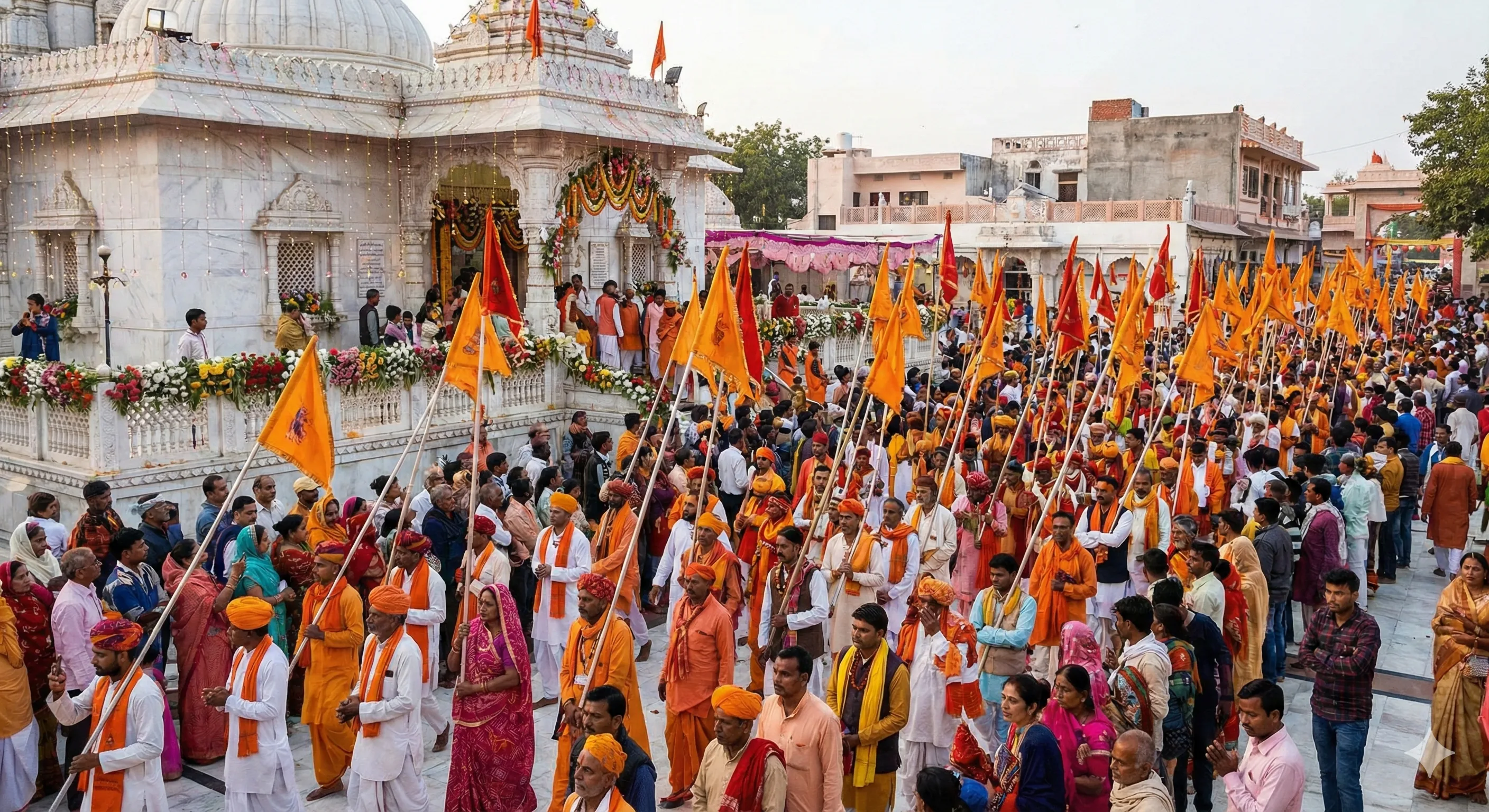
A Nishan is a triangular cloth flag — saffron, orange or red — mounted on a bamboo pole 10 to 20 feet tall, adorned with tinsel, bells and the visage of Shyam Baba. The pilgrimage is primarily an act of vow-fulfilment (mannat).
The Vow
A devotee makes a vow at home: "If my wish is fulfilled, I will walk the Nishan Yatra."
The Walk
17 km from Ringas to Khatu, completely barefoot, chanting "Jai Shree Shyam" — 4 to 6 hours of intentional physical surrender.
The Offering
The Nishan is presented at the temple, darshan received, prasad taken — the vow fulfilled.
For extreme devotion, there is Dandavat Parikrama — the devotee fully prostrates face-down at every single step, extending the 17-km journey across 3 to 4 grueling days, practised by ~5,000 devotees annually. During the Phalgun Mela alone, 2 to 3 million Nishans are offered.
The Attar (Perfume) Ritual
Open & Offer Fully
The first act of surrender.
Open & Offer Fully
The second act of surrender.
Open · Whisper · Close
A wish left pending — returned fully opened once granted.
So powerful is this ritual that local perfumeries report a 300% surge in sales during the mela season.
The Other Festivals
Kartik Shukla Ekadashi
Baba Shyam's Janmotsava — his birthday. ~2,00,000 devotees.
Krishna Janmashtami
The birth of Lord Krishna — midnight darshan and jhankis.
Jhool Jhulani Ekadashi
The deity is placed upon a decorated swing.
Holi & Vasant Panchami
Coloured celebrations in the temple courtyard.
When Millions Walk — The Lakhi Mela
The grand festival. A gathering that grew 300% in fifteen years — now among the largest religious events in all of India.
Two Sacred Dates, One Festival
The Head Re-emerges
The day Barbarika's head miraculously re-emerged at Shyam Kund after centuries submerged — ~1027 CE.
The Head Was Given
The day Barbarika originally donated his head to Krishna at Kurukshetra — ~3102 BCE.
The full festival runs from Ashtami (8th day) through Dwadashi (12th), spanning 10–12 days, with unofficial celebrations extending to Holi (22–25 days). The 2026 mela ran from February 21st to 28th.


The Astonishing Growth
| Year | Attendance | Growth |
|---|---|---|
| 2011 | 15 lakh (1.5 million) | — |
| 2012 | 25 lakh (2.5 million) | +67% |
| 2013 | 35 lakh (3.5 million) | +40% |
| 2018 | ~40 lakh (4 million) | +14% |
| 2023 | 50 lakh (5 million) | +25% |
| 2025 | ~50–60 lakh (5–6 million) | +20% |
| 2026 (projected) | 60 lakh+ (6 million+) | Onward |
Over 300% growth in fifteen years — placing the Phalguna Mela among the top 10 largest religious gatherings in Rajasthan, rivalling the Kumbh on a localised footprint.
Day by Day
Arrival & Encampment
Camps, dharamshalas and Nishan staging areas rise at Ringas. Opening bhajans begin.
The Mass Nishan Yatras Begin
Devotees walk 17–18 km barefoot with flags raised; free Bhandaras open along the route.
24-Hour Darshan & the Rath Yatra
The temple never closes; the chief priest performs the special Abhishek; lakhs of Nishans are offered; and the Rath Yatra takes place.
Kheer-Churma & the White Flag
Special prasad offered and distributed; the Surajgarh White Flag is hoisted.
Gulal in Baba's Court
Many devotees stay on, celebrating colours in Shyam Baba's court.
The Surajgarh White Flag — 300 Years Unbroken
A white flag, adorned with the image of Barbarika's blue horse, originating from Surajgarh on the Haryana–Rajasthan border. The tradition has been unbroken for over 300 years — and carries a history of resistance. Mughal rulers in the 1700s tried to ban the practice; British colonial authorities in the 1800s tried again. The tradition never broke.
The Rath Yatra — A Living 350-Year Tradition
The Idol Leaves the Temple
Held only on Ekadashi of the Phalgun Mela — the one day devotees can see the idol outside the sanctum.
125 kg · ₹1.5 crore
In 2025–26, the idol rides a specially crafted silver chariot weighing ~125 kg, built for ~₹1.5 crore by artisans in Nokha, Bikaner.
Bhandara & Infrastructure
Over 50 permanent Bhandara camps serve an estimated 10–15 lakh meals over 12 days — entirely donation-funded, serving all regardless of caste, religion or nationality. 5,000+ police, 25 medical camps, 8 fire stations, 40 ambulances, 200+ CCTV cameras, 50+ special trains, and a 30+ foot darshan distance during peak hours.
Where Grace Meets the Desperate
The temple's reputation as the refuge of the defeated means it draws those at their lowest point — and it is precisely these devotees who report the most extraordinary interventions.
The Cow & the Sacred Head
A cow's spontaneous, repeated release of milk over a mound led villagers to excavate and discover Barbarika's perfectly preserved, glowing head. The spot is Shyam Kund.
The Bleeding Lingam
At the Gaurishankar Mahadev Temple, a soldier struck the Lingam with a spear. Blood flowed from the strike point — the spear marks remain visible to this day.
"Four Returned, Five Did Not"
Four devotees returning from darshan survived a head-on collision on NH-52 near Churu that killed five in the other vehicle. They attributed survival to chanting "Jai Shree Shyam."
The Kidnapped Child & the "Blue Uncle"
Five-year-old Raksham, abducted during the mela, was found unharmed after five days. He described being comforted nightly by a "blue uncle" — matching Khatushyamji's iconographic blue complexion.
The Delhi Dham Built in 15 Months
Ghanshyam Gupta Zaveri built the grand Delhi Dham — a ~100,000 sq-yd complex with a 19-storey building — in just 15 months, with spontaneous donations exceeding ₹50 crore.
Narmada Kanwar's Dream
The oldest documented devotee story: the queen's dream revealed the exact location of the buried head — the theological basis for the temple's founding.
The Patterns of Reported Grace
| Category | Share | Common Pattern |
|---|---|---|
| Medical Recovery | 28% | "Incurable illness improved after vow & darshan." |
| Financial Reversal | 22% | "Bankrupt business recovered after prayers." |
| Accident Survival | 18% | "Inexplicable survival in severe crashes." |
| Dream Guidance | 15% | "Baba appeared in a dream with a solution." |
| Family Resolution | 10% | "Broken relationships healed after pilgrimage." |
| Child Blessings | 5% | "Conception after years of difficulty." |
| Legal Victories | 2% | "Unexpected favourable court verdicts." |
A Phenomenon in Numbers
From a regional shrine to a national movement in fifteen years.
The Donation Explosion
The Real-Estate Boom
2020 · ₹15,000–20,000 / sq yard
A sleepy village on the edge of the Thar.
2022 · ₹40,000–50,000 / sq yard
The first wave of viral bhajans brings new crowds.
2024 · ₹80,000–100,000 / sq yard
Real-estate investment crosses ₹1,000 crore in five years.
2026 · ₹1,00,000+ / sq yard
A 400–500% appreciation in six years, driven by religious demand.
When a Deity Went Viral
The exponential global rise of Khatushyamji is fundamentally intertwined with the digital revolution and a generation hungry for a non-judgmental refuge.
The Bhajan Music Revolution
| Song | Artist | Views | Impact |
|---|---|---|---|
| "Gazab Mere Khatu Wale" | Kanhaiya Mittal | ~70 million | Launched Khatu to national fame (2020) |
| "Main To Khatu Dham Ko Chala" | Kanhaiya Mittal | 30+ lakh | Increased mela attendance |
| "Lene Aaja Ringas Ke Mod Par" | Various | 50+ million | Made the Ringas–Khatu route iconic |
| "Haare Ka Sahara" | Compilations | 100+ million | Became the devotee anthem |
B.R. Chopra's Mahabharata (Doordarshan, 1988) first brought Barbarika's legend to millions of households. The T-Series Bhakti channel curates playlists generating hundreds of millions of streams in Hindi, Haryanvi, Punjabi, Gujarati and Rajasthani.
"Jai Shree Khatu" — A Community Password
The greeting "Jai Shree Shyam" has effectively replaced "Hello" among millions of North Indians — operating as a communal password that instantly recognises shared faith, frequently leading to spontaneous business networking, job referrals and community support.
Why the Young Flock to Him
| Modern Anxiety | Khatushyamji's Appeal |
|---|---|
| Job-market uncertainty | "The god who helps in failure." |
| Competitive-exam pressure | "A quick response to prayers." |
| Startup failures | "The god of second chances." |
| Social-media comparison | "A non-judgmental refuge." |
| Mental-health crisis | "Understands defeat intimately." |
Over 195 new temples have been established outside Rajasthan between 2010 and 2026 — a growth rate of 15–20 annually. In Vasna, Ahmedabad, he is worshipped as Baliya Dev.
Stewardship of a Sacred Trust
Managing five million pilgrims demands more than faith — it demands reform, transparency, and the hard lessons of tragedy.
The temple is managed by a Public Trust registered under Registration No. 3/86. A 7-member committee oversees daily ritual, the Shyam Kund & Shyam Bagicha, festival coordination, dharamshala management, donation accounting, and a staff of 500+.
Reforms After the 2022 Stampede
During the 2022 Phalguna Mela, a stampede took the lives of three women devotees. The trust responded with sweeping reform:
Land Acquisition
10 acres added for crowd-dispersal zones.
VIP Access Shut
14 backdoor "paid darshan" routes permanently sealed.
Queue Management
Barricaded, zig-zag time-slot lanes during peak.
Police Deployment
Increased from 2,000 to 5,000 during the mela.
CCTV Coverage
200 cameras across the complex.
Medical & Fire
25 first-aid camps, 40 ambulances, 8 fire stations.
A Village Becomes a National Hub
Government investment — verified in Parliament — is transforming Khatu into a model of religious tourism.
| Project | Cost | Agency | Status |
|---|---|---|---|
| Krishna Circuit (Swadesh Darshan, 2016) | ₹75.80 Cr (₹24.60 Cr for Sikar) | Central Govt | Sikar works completed |
| Temple Corridor | ₹100 Cr | Rajasthan Govt | Under construction |
| Ringas–Khatu Rail Line | ₹254 Cr | Indian Railways | Approved 2024 |
| Ujjain–Khatu Religious Circuit | MoU signed | Rajasthan & MP | Vande Bharat & e-buses |
The Road Ahead
~75 lakh at the Phalguna Mela
Sustained 15–20% CAGR if infrastructure keeps pace.
~1 crore (10 million)
Temple corridor fully operational; rail line connecting Khatu to Ringas.
~1.5 crore — potential Tirupati scale
If projected mega-projects — Khatu Airport, Jaipur–Khatu metro, a Barbarika Heritage Museum — materialise.
A Gallery of Devotion
Click any image to explore in full. A visual journey through the deity, the temple, and the sea of faith.

The Enduring Power of Surrender
Barbarika represents one of the most profound spiritual paradoxes in all of religious history.
The Most Powerful
…who never raised his sword in anger.
The Supreme Sacrifice
…that won no battle.
The Defeated Hero
…who became immortal through loss.
The God of Losers
…worshipped by millions of winners.
"You are allowed to fail. You are allowed to be defeated.
And there is still a god who accepts you."
Sources & Glossary
Glossary of Sacred Terms
Barbarika
His original name; grandson of Bhima.
Sheesh Daan
The donation of the head.
Teen Baan
The three divine arrows.
Nishan
The triangular devotional flag.
Ekadashi / Dwadashi
The 11th / 12th lunar day.
Bhandara
Free community food distribution.
Garbhagriha
The sanctum sanctorum.
Sharanagati
Complete surrender to the Divine.
Complete Reference List
[1] Blog.dharmikvibes.com (2025). Khatushyam Ji: The Deity of Faith and Surrender.
[2] Wikipedia. Khatu Shyam Temple.
[3] Rudraksha-ratna.com (2025). About Baba Khatu Shyam Ji.
[4] Wikipedia. Barbarika.
[5] Wisdomlib.org (2019). Ch. 60 — The Birth of Barbarīka (Skanda Purana).
[6] Mysutradhar.com (2024). Story of Barbarika in Skanda Purana.
[10] Wisdomlib.org (2019). Kṛṣṇa beheads Barbarīka.
[11] The Print (2025). Khatu Shyam is young India's new god.
[12] Khatushyambaba.com. Temple Profile.
[13] IJFMR (2024). A Study on Khatu Shyam Temple Rajasthan.
[14] Devasthan Department, Rajasthan (2006). Khatushyamji, Sikar.
[17] Khatu.org (2023). Khatu Dham.
[18] Khatu.org (2023). Khatu Shyam Falgun Lakhi Mela.
[22] Shyambaba.in (2024). Festival of Khatu Shyamji.
[23] Wikipedia. Phalguna Mela.
[25] Utsav.gov.in (2023). Khatu Shyam Mela.
[27] Devasthan Dept., Govt. of Rajasthan (2016). Development & Management Plan — Structwel & ANB Consultants.
[28] Youteek.com (2025). Khatu Shyam Baba's Real Miracle.
[29] Dvaipayana.net. Summary of Barbarīka Upākhyāna, Skanda Purāṇa (Ch. 59–66).
[31] Khatudarshan.com (2025). खाटू श्याम रथ यात्रा.
[33] News18 Hindi (2026). 125 किलो चांदी के रथ पर निकलेंगे बाबा श्याम.
[35] Dainik Bhaskar (2026). डेढ़ करोड़ के रथ पर निकलेंगे बाबा खाटूश्यामजी.
[36] Ministry of Tourism, Govt. of India (2022). Lok Sabha Unstarred Q.303.
[39] Khatu.in (2026). Khatu Shyam Temple History.